The true cost of re-waxing a jacket yourself

Updated: Jan 5
Given that you're quite likely already in possession of a waxed jacket, or perhaps on the verge of acquiring one, I'd like to offer you a concise overview of what it actually costs to wax your own jacket.
When compared to utilising a professional reproofing service, such as my own, the expense is roughly half at first, a rather compelling saving, I must say. In this modest little piece, I shall explain precisely what you'll need and provide you with an indication of the associated costs.
Initial investment
By initial investment, I'm referring to the modest outlay required for the tools and equipment necessary to wax your jacket properly. Of course, there's a fair chance you already have most of these items tucked away in your shed or hobby room, but I'll mention them nonetheless, along with their approximate prices, just to be thorough.
Heat gun - This is essential for ensuring the wax penetrates the fabric evenly. A decent heat gun needn't break the bank, and you'll find it useful for countless other projects around the house. Think of it as a worthwhile addition to your toolkit that extends well beyond jacket maintenance.
Rubber gloves - Rather important, I'd say, unless you fancy spending the next few days with greasy hands and a greasy smartphone screen. A sturdy pair will protect your skin from the hot wax and make the entire process considerably more pleasant. You probably have a pair in your kitchen cabinet.
A piece of cotton cloth - This is what you'll use to work the wax into the fabric. An old tea shirt with holes in it or any clean cotton rag will do perfectly well. Nothing fancy.
A brush - Useful for applying wax to seams and difficult-to-reach areas, ensuring comprehensive coverage across the entire garment. Do make sure to buy a non-synthetic brush as synthetic brushes might melt while treating your wax with a heat gun at the same time while spreading the wax.
Reoccurring costs
Here, naturally, I'm talking about the wax itself. And this is where you have two distinct approaches to consider. If you're something of an enthusiast like myself, someone who relishes DIY projects and takes genuine pleasure in the craft, you might consider blending your own wax. Now, it's worth noting that this only makes sense if you're confident you'll be waxing with some regularity, say annually at minimum. Otherwise, you'll find yourself with rather more stock than you can reasonably use. Should you wish to learn how to blend your own wax, I've written a separate article on the subject which you might find illuminating.
For those interested in the self-blending route, here are the key ingredients:
Beeswax - The traditional base that provides water resistance and that characteristic finish. It's remarkably versatile and forms the foundation of most wax blends.
Paraffin wax or Carnauba wax - These adjust the consistency and durability of your mixture. Paraffin softens the blend slightly, whilst carnauba offers exceptional hardness
Baby oil - This keeps the wax supple and prevents the fabric from becoming overly stiff. It's the secret ingredient not many know about but that ensures your jacket remains comfortable to wear.
Alternatively, for those who prefer convenience:
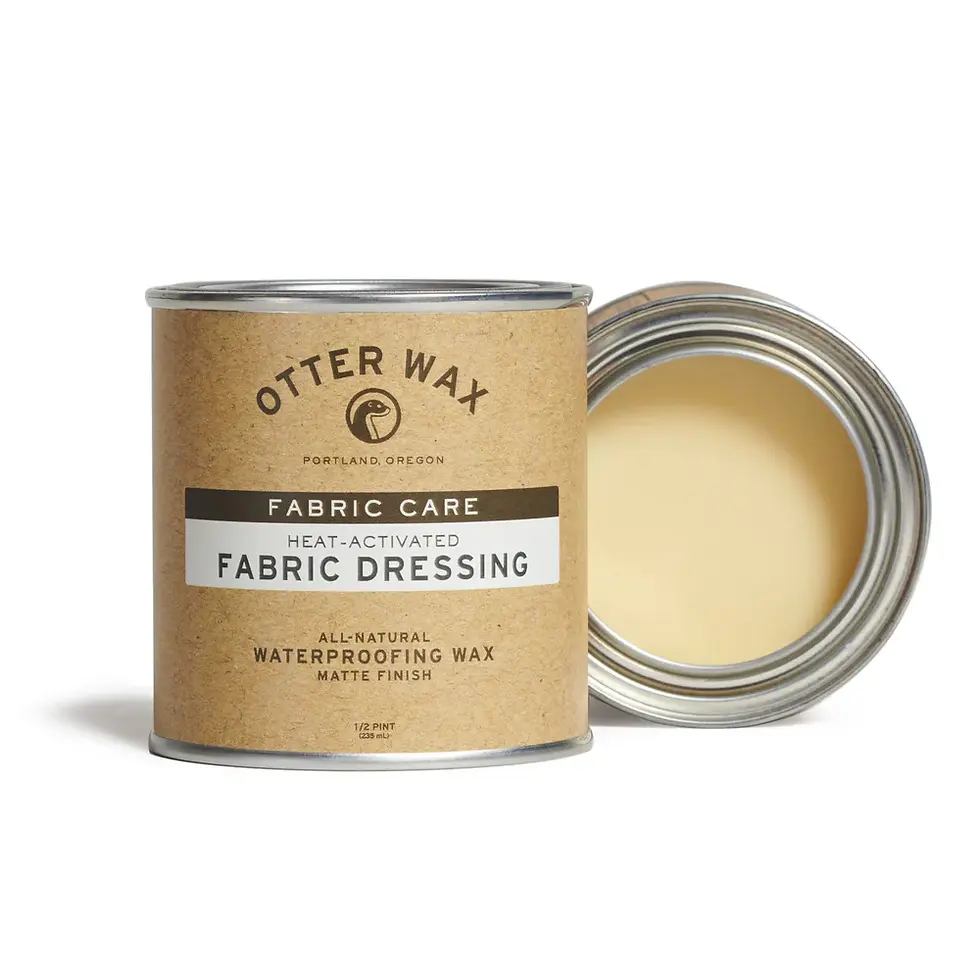
Ready-blended wax from Barbour or Otter Wax or any other variant you might find
These established brands offer excellent formulations that take all the guesswork out of the equation. Simply apply and you're done. That simple? Well, sort of yes.
Taken the cost of re-waxing a jacket yourself into account; which route should you choose?
I think the first consideration ought to be what actually appeals to you personally. I must confess, I've developed an enormous affection for the ritual of waxing. I find it thoroughly satisfying to prepare the workspace, melt my own wax blend, contemplate the specific purpose the commissioned jacket will serve, and then adjust the stiffness of the wax mixture accordingly. There's something rather meditative and mindful about integrating all these elements into my re-waxing routine. You can imagine that, given the frequency of my waxing activities, it's considerably more economical for me to blend my own wax. Several times a year, I prepare a batch of wax in soap-bar-sized blocks, which I then use throughout the year, making subtle adjustments depending on the type of jacket I'm treating.

However, if you're only waxing a jacket once every couple of years, it's undoubtedly far more cost-effective to purchase ready-made wax. There's no sense in accumulating ingredients you'll barely use.
That said, I'd also like to encourage you to think about the longer term. I recently wrote an article examining the true cost of owning a waxed jacket over its lifetime. The fundamental conclusion is this: when you invest in a waxed jacket with the intention of keeping it for twenty years, you'll likely wax it at least ten times, ideally more. When you divide the maintenance costs by ten or twenty applications, it truly becomes a mere fraction, and the expense essentially becomes a non-issue.
I do hope you'll read my article and begin thinking more about the long-term perspective when purchasing clothing. This approach benefits not only the environment and our planet but also, rather pleasingly, your own wallet as well. It's about embracing quality over quantity and finding satisfaction in maintaining something properly rather than simply replacing it, a mindset I believe we could all benefit from adopting more widely.

